A last-minute Christmas gift for parents: a printable life-story gift card
A free printable card that gives your parents one recorded afternoon of their stories in January, with a 20-question booklet. Print it the night before.
By The Yourtale team · Published 26 November 2026 · 14 min read
A last-minute Christmas gift for parents that does not depend on shipping is your time, put on paper. Print our free card tonight, write a day in January inside it, and give it on the 25th. On the day you wrote in, you sit down together with the twenty questions in the booklet and record the conversation on your phone.
It is the week before Christmas and the parcels are not going to make it. The US Postal Service gives December 17 as the recommended last day to send USPS Ground Advantage and First-Class Mail in the lower 48 states and still arrive by Christmas this year, December 18 for Priority Mail and December 19 for Priority Mail Express. After that, a gift for your parents has to come from a shop, arrive by email, or be made at home.
We read the pages that come up for this search on 26 November 2026. Wonderbox opens on the problem everyone has ("your parents 'don't need anything,' and you still have no gift") and answers it with experience vouchers that "can be sent instantly by email as an e-voucher." Storii's list runs to fourteen ideas, from a family recipe book to a meal delivery plan, and puts its own subscription first. Two of its ideas point at something better than an object: "print out the gift voucher and place it in a decorative envelope," and make a "day plan" itinerary for a day of activities together. Neither says what to do with the afternoon once it comes.
This page does. It is a card you print at home that promises one afternoon in January with a written date, and a booklet of twenty questions to fill that afternoon with. The conversation is recorded on your phone, and the recording is the part that lasts.
Key takeaways
- Nothing has to ship. The PDF is four pages: the card on the first, folded from one sheet, and a three-page booklet. It prints on any home printer.
- The card buys nothing. It is a promise from you, not a voucher for a product. We do not sell it, and nothing on it needs us.
- Write a real date on it. A card with no date waits in a drawer. In a Bankrate survey, 43 percent of US adults had at least one unused gift card, voucher or store credit, worth $244 on average.
- People value sentiment more than givers expect. In three studies, givers chose gifts that matched a recipient's stated tastes over sentimental ones much more often than recipients would prefer.
- One afternoon, twenty questions, one at a time. The booklet starts with Christmas when they were seven and ends with what a great-grandchild should know.
What is a good last-minute Christmas gift for parents?
One that does not depend on a delivery date and is about them rather than their house. Most last-minute advice is the year's gift guide with a shipping warning added. A promise of time is the exception, because it needs only paper, and it is the kind of gift the research suggests parents value more than the person buying expects.
Three findings from consumer psychology are worth knowing before you choose.
Givers play it safe, and recipients notice. Julian Givi and Jeff Galak asked people to choose between a sentimentally valuable gift and one that simply matched the recipient's known tastes. In their 2017 paper, givers picked the preference-matching gift "much more often than recipients would prefer to receive such gifts". The reason was certainty. Givers felt sure the safe gift would be liked and unsure about the sentimental one.
Experiences bring people closer than objects. Cindy Chan and Cassie Mogilner tested real gift exchanges between people who knew each other. Experiential gifts produced greater improvements in relationship strength than material gifts, "regardless of whether the gift giver and recipient consume the gift together." The effect came from the emotion people felt while living through the gift, "rather than when the gifts are received."
The moment of unwrapping matters less to the recipient than to you. In a 2016 review of gift-giving mistakes, Jeff Galak, Julian Givi and Elanor Williams argue that givers focus on the moment of exchange, while recipients focus on how valuable a gift will be once owned. A folded card is a quiet thing to unwrap. Its value arrives in January.
None of these studies tested a recorded life-story conversation, so read them as support for the kind of gift, not proof that your father will love it. What they do suggest is that the worry stopping most people (that it is too personal and might fall flat) is bigger on the giving side than on the receiving side.
What is in the free printable?
Four pages in one PDF, in US Letter or A4. The card takes the first sheet. The booklet takes the other three, and you can staple it in the corner or leave it loose.
| Page | What it is | What it is for |
|---|---|---|
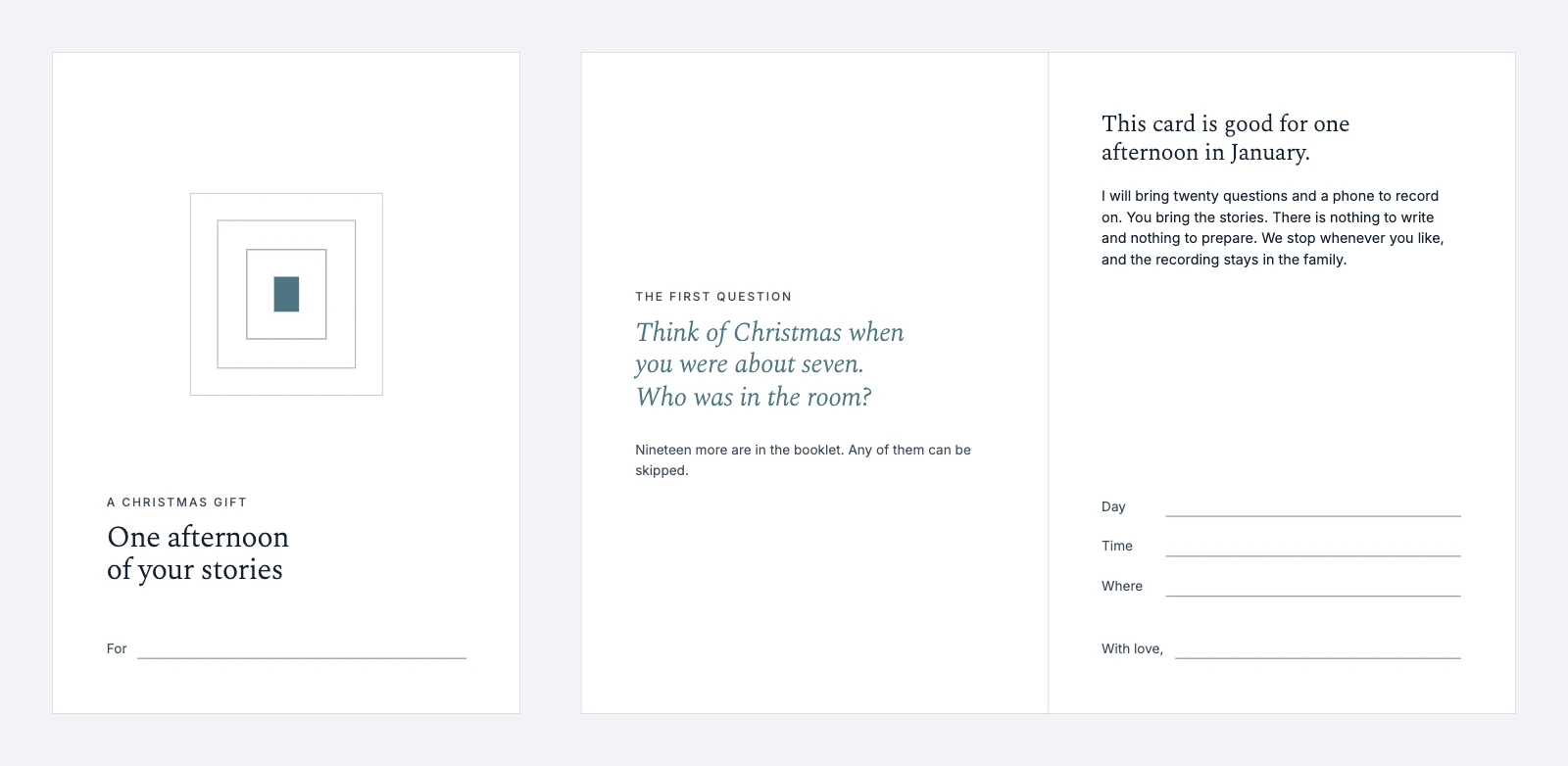
| 1 | The card | Front, inside left, inside right and back, printed on one side of one sheet and folded twice. The front says "One afternoon of your stories" with a line for their name. The inside has the first question, the promise, and lines for the day, time and place. |
| 2 | Before you start | For you, the giver: how to set up the room and the phone, three follow-up questions that work on any answer, what to do with the file afterwards, and how to fold the card. |
| 3 | Questions 1 to 10 | Where they started, and their first years out in the world. Each question has a box to tick and a line for a note. |
| 4 | Questions 11 to 20 | The people in their life, and looking back. |
The card is set in the same type as this site, with the four concentric rectangles we use everywhere in place of a picture. There is no Christmas tree on it and no holly. It reads as a letter from you, and the only branding is a small mark and the web address on the back.
How do you print and fold the card?
Print page 1 on one side of a normal sheet of paper, at actual size. Heavier paper, around 65 lb cover or 176 g/m², makes a stiffer card, but ordinary printer paper works.
- Print it on one side only. The card is laid out so that the inside comes out the right way up once it is folded. Two of the four panels are printed upside down on the sheet, which is how it should look.
- Fold the sheet in half across the middle, printing on the outside. The top half goes behind the bottom half.
- Fold it in half again, so the rectangles are on the front. The small ticks at the edges of the sheet mark both folds.
- Open it. The first question is on the left, the promise is on the right, and the web address is on the back.
The finished card is a quarter of the sheet: 4.25 by 5.5 inches from Letter, which fits an A2 envelope, or A6 from A4, which fits a C6 envelope.
What do you write on the card?
Four things: their name on the front, then a day, a time and a place inside, and your name under "With love." This is the text already printed inside:
This card is good for one afternoon in January.
I will bring twenty questions and a phone to record on. You bring the stories. There is nothing to write and nothing to prepare. We stop whenever you like, and the recording stays in the family.
The date is the part that makes it a gift. Gift cards top the wish lists again in the National Retail Federation's October 2026 survey of 8,094 US adults, with 47 percent saying they would like one. The same format has a known weakness. When Bankrate and YouGov surveyed 2,373 US adults in August 2024, 43 percent had at least one unused gift card, voucher or store credit, with a median of $100 and an average of $244. A homemade coupon for "one afternoon together, any time" goes into the same drawer.
Wonderbox sells the opposite as a feature: with its vouchers, "they choose the date, the place and the activity." For a voucher that is fine. For a conversation with a parent who will say "oh, you don't need to do that," choosing later means never. So choose now. In 2027 the first Sunday in January is the 3rd and the second is the 10th. Check with a brother or sister before you write it in, and write it in ink.
Write a name, not a role. "For Mom" is fine. "For Margaret, who has never once told me about Coney Island" is better, and gives them a hint of what you are going to ask.
If the gift is for both parents, make two cards. Ask each of them alone first. Our page on the Christmas gift for parents who have everything explains why one sitting together and one apart gets you two versions of the same story, and why you want both.
Why does the card say January and not Christmas week?
Because the person searching for a last-minute gift usually has no free afternoon left in December, and a conversation squeezed between the dishes and the drive home tends to stay short.
If you will be with your parents in the quiet days after Christmas, start then. Our pages for a mom who has everything and a dad who has everything plan the sittings for Christmas week. The card says January for the rest of us. January also helps the gift itself. The present is opened in a room full of other presents, and the afternoon happens weeks later on its own, with nothing else competing for it.
Which twenty questions are in the booklet?
The questions run in four parts of five, from childhood to looking back. We wrote them for this card. Each asks for one scene rather than a summary, because "Walk me through the front door" gets a story and "Tell me about your childhood" gets a shrug. The first one is printed inside the card, so they know what is coming and can think about it over the holidays.
Prints the twenty questions on one sheet. The PDF has the card and the full booklet.
Twenty questions for one afternoon
Ask one at a time and wait for the answer. Skip any that do not fit, and tick the box when a question has been asked.
Where you started
Think of Christmas when you were about seven. Who was in the room?
Walk me through the front door of the house you grew up in. What do you see first?
What were you allowed to do on your own as a child that nobody would allow now?
Which grown-up outside the family did you like best when you were small?
What did you get in trouble for most often?
Out into the world
What did you do with the first money you ever earned?
What did the first place you lived away from home look like inside?
What was an ordinary Saturday like when you were twenty-five?
What were you good at in your work that nobody gave you credit for?
Which piece of news do you remember exactly where you were when you heard it?
The people
Tell me about the day you met the person you married, or the person who mattered most.
What was your mother like on an ordinary weekday, when nobody was visiting?
What do you do that you got from your father?
What do you remember about the day your first child was born?
Who was your closest friend when you were thirty?
Looking back
If you could live one year of your life again, which year would it be?
Which decision of yours turned out better than anyone expected?
What did you worry about that turned out not to matter?
What have you changed your mind about?
What should a great-grandchild know about you that they would never guess?
Questions from the printable life-story gift card, yourtale.art/en/blog/printable-life-story-gift-card. Free to print and copy.
Twenty is about right for an hour. Some questions take thirty seconds and some take twenty minutes, and you will not get through all of them, which is fine. Question 13 is the one we would not skip. Nobody has a prepared answer to it, so it gets worked out aloud. Question 20 is a good place to stop, even if you skipped half the list to get there.
If the afternoon goes well and you want more, our 150 life story questions go stage by stage through a whole life, and our 42 interview questions are the list our own interviewer works from.
How do you record the afternoon on a phone?
With the voice recorder that is already on it: Voice Memos on an iPhone, or the recorder app that came with an Android phone. You do not need a microphone or an app to buy. The first page of the booklet has the same steps, so you do not have to remember them on the day.
- Sit at the corner of a table, not across it. Close enough that the phone can lie between you, and in a room where the television is off.
- Turn on Do Not Disturb. A call or a stream of messages should not interrupt the recording.
- Start recording before the first question, and say the date and both your names. It labels the file for whoever finds it in thirty years.
- Put the phone down screen up, and leave it alone. A phone lying on the table is easy to forget. One held out toward them is not.
- Ask one question, then wait. A silence usually means they are remembering. When an answer is short, use one of the three follow-ups printed in the booklet: "What happened next?", "Who else was there?" and "What did it look like?"
- Stop after about an hour, while it is still going well. End on a good story, not when you have run out of questions, and the next afternoon starts warm.
Save the file the same day, name it with the date and their name, and copy it somewhere other than the phone. If you want to go further, our guide to recording a life story sets out the five paths from talking to a book, and how to keep a parent's voice in it.
How do you give it on Christmas Day?
Give it last, and read the inside aloud. A folded card in a pile of boxes is easy to miss, and a promise sounds different in your voice than in print.
- Put the booklet in the envelope with the card. They can read the questions over the holidays and start remembering before the day.
- Expect "Who would want to hear that?" You would, and the first question is the answer. Ask it right there if they want to start: "Who was in the room when you were seven?"
- Keep it light. This is an afternoon of stories, not a conversation about getting old. Leave out "before it's too late" and anything else with a clock in it.
- If you want something to unwrap, add one photograph of them from before you were born, in a cheap frame. It will come up on the day.
If a parent tends to wave off questions about the past, our guide to what to ask a parent who does not want to talk sorts the common reasons and the opening that fits each.
Does it work for grandparents, or a parent who lives far away?
Yes to both. For grandparents, the questions work as they are. Question 14 is then about the birth of their first child, who may be your mother or father, and it is a story you rarely hear told by someone who was there. Our page on the Christmas gift for grandparents has twelve more questions written for them, and suggests giving a grandchild the job of asking.
If they live far away, write a phone or video call on the card instead of a place. Put the call on speaker and record it on a second phone or a laptop. Say at the start that you are recording, and keep that on the recording too. Recording a far-away parent's story covers the setup for a video call, what to do when a parent will not get on one, and whether you need permission to record.
What happens to the recording after the afternoon?
It is yours to keep, and that is enough. A recording of a parent telling twenty stories in their own voice is worth having even if nobody ever types up a word of it.
If you want more than the recording, there are three next steps. Book a second afternoon before you leave, while the first is still fresh. Get the file transcribed, so you can search it and read it. Or turn the transcripts into chapters, which is the long version and takes months, not weeks. How long it takes to write a memoir has the honest arithmetic.
If you would rather we did the interviewing: we interview parents and grandparents by phone, and the conversations become a book. Here is how it works.
Frequently asked questions
What is a good last-minute Christmas gift for parents?
One that does not depend on shipping and is about them: a promise of your time with a date on it. Our free printable card promises one afternoon in January to record their stories on your phone, and comes with a booklet of twenty questions. It prints at home on four pages and needs nothing else.
Is the printable gift card free?
Yes. The PDF is free in US Letter and A4, and you can print it as many times as you like. The card does not buy anything from us or anyone else. It is a promise from you, and everything it needs is a phone and an afternoon.
How do I fold the printable gift card?
Print page 1 on one side of the sheet. Fold it in half across the middle with the printing outside, so the top half goes behind the bottom half. Then fold it in half again so the rectangles are on the front. The inside comes out the right way up, and the card fits a standard greeting-card envelope.
What should I write on a homemade gift card for my parents?
Their name, what the card is good for, a real date and place, and your name. A card that says "one afternoon, any time" tends to stay in a drawer, so write in a day: the first Sunday of January 2027 is the 3rd. Ours already has the promise printed inside, with lines for the day, time and place.
Why is the conversation in January and not on Christmas Day?
Because Christmas week is full, and a conversation squeezed in between other plans tends to be short. In January the afternoon has nothing competing with it. If you will be with your parents in the quiet days after Christmas, you can start then instead and write that date on the card.
What if my parents live far away?
Write a phone or video call on the card instead of a place, and record the call. Say at the start that you are recording, and keep that on the recording. The twenty questions work the same way over the phone, and you can hold one call per part of the booklet if an hour is too long.
Can I give the card to both parents at once?
Make two cards, one for each, and hold the first conversations apart. A shared story often comes out differently when the other one is not in the room, and you want both versions. Afterwards, an afternoon with both of them together can fill in what each one forgot.
Sources
How we made this: we read the pages that rank for "last minute christmas gift for parents" on 26 November 2026, wrote the twenty questions for this page, and designed the card to print on one side of one sheet. The questions in the PDF are built from the list on this page by a script, so the booklet and the page always match. This article was written with the help of AI, and every figure and quote was checked against the sources below on 26 November 2026.
- US Postal Service, "2026 Holiday Shipping Deadlines", dates for the contiguous US, retrieved 2026-11-26.
- National Retail Federation, "Affordability shapes winter holiday shopping, according to NRF holiday survey", survey of 8,094 adults conducted October 1 to 7, 2026 by Prosper Insights & Analytics, retrieved 2026-11-26.
- Bankrate, Katie Kelton, "Survey: 43% of Americans have at least one unused gift card", published 23 September 2024, YouGov survey of 2,373 US adults, fieldwork 19 to 21 August 2024, retrieved 2026-11-26.
- Givi, J. and Galak, J. (2017), "Sentimental value and gift giving: Givers' fears of getting it wrong prevents them from getting it right," Journal of Consumer Psychology, abstract retrieved 2026-11-26.
- Chan, C. and Mogilner, C. (2017), "Experiential Gifts Foster Stronger Social Relationships Than Material Gifts," Journal of Consumer Research 43(6), abstract retrieved 2026-11-26.
- Galak, J., Givi, J. and Williams, E. F. (2016), "Why Certain Gifts Are Great to Give but Not to Get," Current Directions in Psychological Science, abstract retrieved 2026-11-26.
- Wonderbox, "Last minute Christmas gifts for parents" and Storii, "Thoughtful Last-Minute Christmas Gifts for Parents", read 2026-11-26.